TFD Furthers Bioenergy for Forests Initiative in the Pacific Northwest
By Eve Cooke ’27 MF, TFD Communications Associate
Bioenergy from Forests (BEF) is made by burning by-products of forest harvests, including logged wood, wood waste such as limbs, and other biofuels derived from wood. This fuel source has sparked substantial debate among researchers, stakeholders, and communities. In the context of climate change mitigation, some view BEF as a renewable substitute for fossil fuels while reducing fire fuel loads in forests, and others question its environmental and social tradeoffs. To explore this topic, The Forests Dialogue (TFD), in partnership with the Yakama Nation and Sustainable Northwest, convened a field dialogue from June 16-20, 2025.
Throughout the 2025 Pacific Northwest Field Dialogue, participants delved into the diverse ecological, economic, and cultural contexts surrounding BEF in the region, identified fracture lines (or key areas of conflict between stakeholder groups) and pathways toward addressing barriers and concerns, and considered how to define and measure sustainability across landscapes. The 31 participants represented academia, research institutions, the Yakama Nation, government agencies, the private forest sector, local and rural communities, and environmental NGOs from across the region, the United States, and ten other countries.
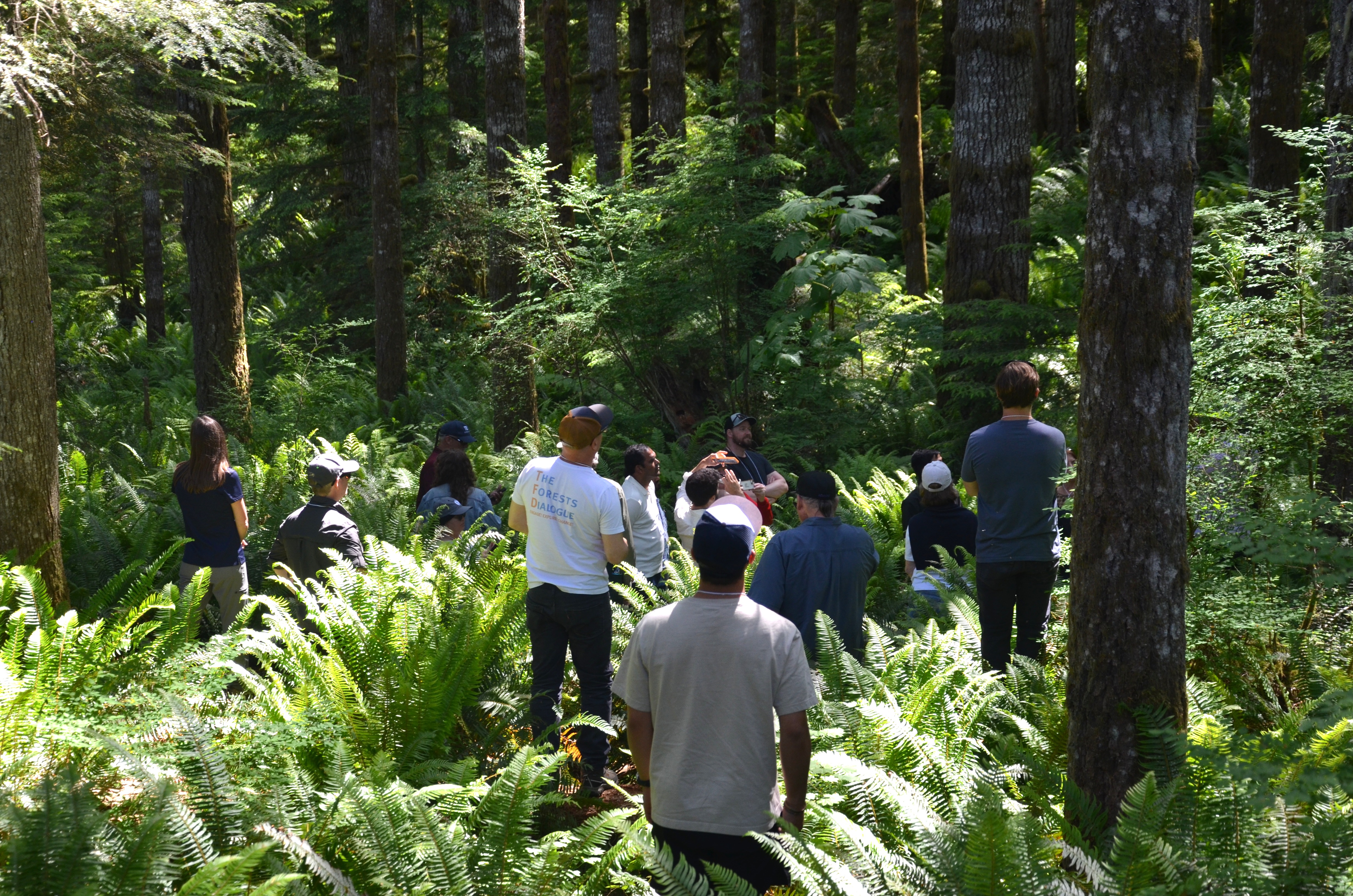
Dialogue participants engage in conversation while taking part in a guided forest walk at the Mount St. Helens Forest Learning Center. Photo: Jane Dowd
The 2025 Dialogue builds on BEF Initiative’s first event, the February 2024 Scoping Dialogue, co-convened with The Forest School at the Yale School of the Environment. A central question emerging from the Scoping Dialogue concerned how increased harvest for biomass might affect sustainable forest management at the regional level. This inquiry guided the design of the 2025 Pacific Northwest Field Dialogue.
The Pacific Northwest represents a critical and complex setting for understanding management of Bioenergy from Forests. Washington State and several port authorities are proactively exploring BEF-related business partnerships. At the national level, forest biomass harvested from federal lands is excluded from the U.S. Renewable Fuel Standard (RFS). This federal restriction limits the market viability of BEF.
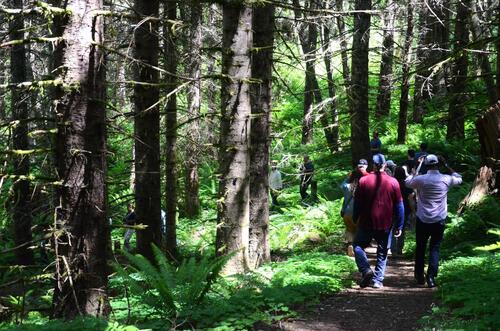
For the first half of the dialogue, eight site visits allowed participants to engage directly with local management practice. On the first day, the group visited forests in Western Washington. Attendees met with members of Chinook Nation and with Weyerhaeuser’s By-Products Manager, and they visited Port Blakely’s forestlands at Winston Creek. On day two, participants traveled east to the drier forests of Washington. Field stops included Oak Creek Forest, co-managed by the Washington Department of Fish and Wildlife (WDFW) and the Yakama Nation. At the Yakama Forest Products headquarters, Tribal staff explained workforce shortages, challenges securing long-term contracts, and the need for mill upgrades.
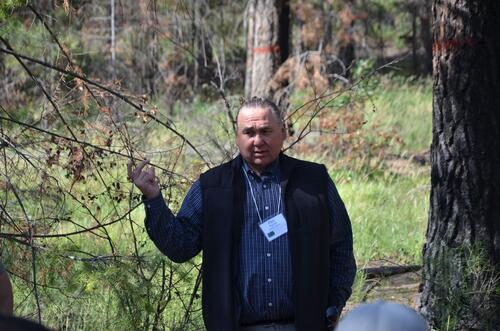
Phil Rigdon ’02 MF, enrolled member of the Yakama Nation, vice president of the Intertribal Timber Council, and co-chair of the Bioenergy from Forests in the Pacific Northwest Dialogue, addresses dialogue participants. Photo: Jane Dowd
Throughout the site visits, the importance of mitigating wildfires was front of mind. At the Oak Creek Forest, participants observed a large area recently affected by fire. On-site, representatives from WDFW and the Yakama Nation discussed the ongoing wildfire threat, opportunities for log salvage, potential biomass markets, and key environmental considerations. Because the region is highly fire-prone, prescribed burning is used as a mitigation tool. Managing tree density is also critical for maintaining ecosystem health and reducing the likelihood of flames reaching the canopy. Additionally, due to high hauling expenses, limited markets, and little demand for wood by-products, full trees are rarely utilized in today’s forestry economy. This means the remaining “slash” is typically left on-site, where it can fuel more intense wildfires and worsen smoke-related health problems. By expanding the market for forest residuals from harvest or environmental disturbances, many Dialogue participants see scaling up BEF as a market-driven opportunity to shift from reactive wildfire suppression to proactive risk reduction.
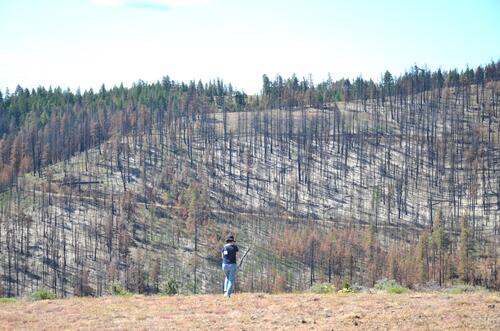
Barbara Reck, senior research scientist at the Yale School of the Environment, observes an area of the Oak Creek Forest burned by a recent fire. Photo: Jane Dowd
In the second half of the dialogue, participants worked in plenary and small group sessions to identify challenge areas for BEF development in the region and developed action plans around prioritized opportunities. The obstacles to BEF management revolved around the following themes:
- Market and Economic Constraints: Limited profitability due to low biomass prices, high transportation costs, and weak infrastructure make it hard to attract long-term investment in BEF.
- Policy and Regulatory Barriers: Inconsistent state and federal policies, unclear definitions of renewable biomass, and complex permitting slow project development and create uncertainty.
- Workforce and Capacity Gaps: An aging workforce, lack of training programs, and limited technical expertise reduce the ability to sustain and expand BEF operations.
- Public Trust and Social License: Misinformation and low public awareness about forest management and biomass energy lead to skepticism and resistance from local communities.
- Equity and Tribal Inclusion: Insufficient funding and limited decision-making power restrict Indigenous and underrepresented communities from leading or benefiting from BEF projects.
- Project Implementation Challenges: Outdated infrastructure, long supply chains, and difficulty scaling small pilot projects hinder progress from local innovation to regional adoption.
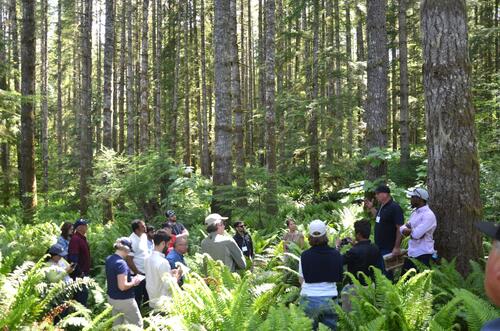
Participants take part in a field visit to the Port Blakely plantation along Winston Creek. Photo: Jane Dowd
The following top recommendations emerged from these discissions:
- Advocate for a revised definition of “woody biomass” in the Renewable Fuel Standard (RFS) that includes residual woody material produced through maintaining federal lands.
- Expand the Tribal management of federal lands as a culturally rooted, ecologically strong pathway for stewardship.
- Leverage multiple revenue streams for BEF projects: payments for carbon sequestration, ecosystem services (e.g., water, biodiversity), fire-risk reduction, and cultural or wildlife values.
More details can be found in the Co-Chair Summary.
Building on this dialogue, TFD plans to convene a subsequent field dialogue in the Southeastern United States and is exploring international forums to advance the Bioenergy from Forests initiative further.